Democracy & Transparency
The Roundtable: Big Media Caught In Secret Dinners, Pulse & Gov Lie On Media Deals
TDMG has confirmed that on 8 July 2025, the Tasmanian Liberal Party privately hosted senior journalists from the ABC, Mercury, Examiner, Pulse and other outlets at an undisclosed dinner on Flinders Island. The event, almost hidden from any official logs, occurred after the Premier’s press conference. Multiple attendees confirmed the gathering, with one noting Pulse’s Josh Agnew was “actively working the room”. The revelation highlights unequal access within Tasmania’s media landscape and reinforces CONTROLLED’s central finding: political power and proximity are concentrated among a small, closed group of outlets.

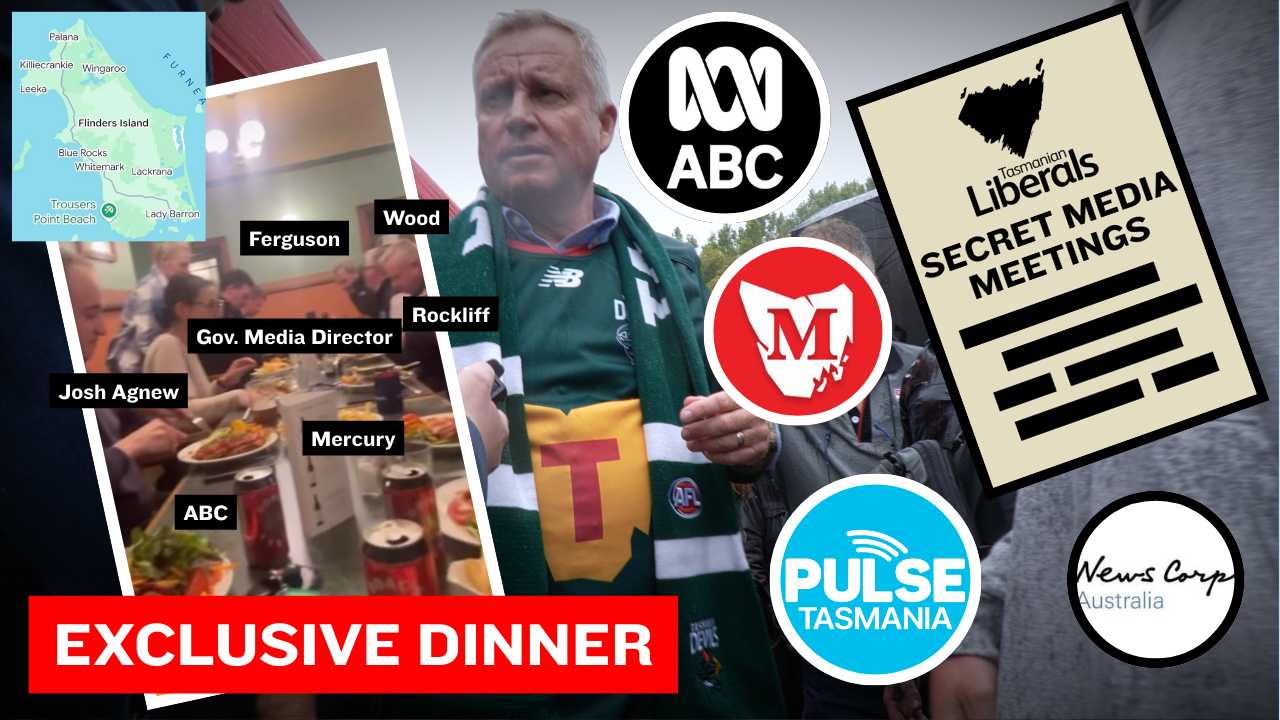
TDMG has obtained fresh evidence confirming that, on 8 July 2025 during the state election campaign, the Tasmanian Liberal Party privately invited senior journalists from the ABC, The Mercury, Examiner, Pulse and other News Corp titles to a dinner on Flinders Island. An invitation which has not been made public anywhere else until now.

The gathering took place at the Flinders Island Interstate Hotel, immediately after Premier Jeremy Rockliff’s official media conference on the island that day. Location and timing are corroborated by image comparison, ministerial diary entries and multiple sources. The event was never publicly disclosed and written off as a “hotel visit” by the government rather than an actual “meeting” or “media” log. There is no evidence that independents (excluding “Pulse Tasmania”) or non-corporate Tasmanian media outlets received an invitation. TDMG is still investigating.

Journalists who attended have confirmed that the Liberal Party and Tasmanian Government did not pay for flights, accommodation or meals with all costs covered by the individual outlets or journalists.
Prior to contacting other outlets, we invited Josh Agnew to provide comment on his participation. Pulse Media told TDMG the original video of the dinner was posted by a Mercury journalist, not by anyone from Pulse. Mr Agnew accused TDMG of deliberately obscuring the identity of the original poster (the redaction was made by our source either intentionally or unintentionally not by us). We were also accused of failing to contact other political parties when we shared the same image to the Premier’s office.
Separately, a journalist from one of the invited legacy outlets told TDMG on background of what occurred:
“Several of my colleagues remarked afterwards that Josh was the only person actively working the room. It felt awkward, the rest of us were just eating and keeping it professional, but he was clearly trying to get close to the Premier and the MPs.” – Anonymous Journalist (Paraphrased)
The picture being painted that veteran news outlets are not surprised and somewhat often attend dinners and visits, while up-and-coming media groups like Pulse are climbing the ranks and being proactive in any events or meetings with the government/party, whether that be collaborations, advertising deals, dinners or catching up with a politican.
The admission of new evidence provides TDMG and the public an alternative viewpoint into the case relating to Pulse Tasmania, where rather than advocating for Liberal policies the motivations of Mr Agnew could be of financial interest and moving towards the party.
Later, Rockliff’s team broadcasted their regional “wins” during the campaign on July 14, shading Labor’s Dean Winter for ghosting Flinders/King Islands, all while conveniently airbrushing the fact they initiated a fly over of all the state’s media in a private schmooze six days earlier.
TDMG has contacted Tasmanian Labor to ask whether they have ever hosted similar off-island media dinners or exclusive media events during election campaigns. Labor has not responded at the time of publication.
This update reinforces the central point of our investigation “CONTROLLED”: in Tasmania, access to the most powerful political figures is not evenly distributed, and some outlets pursue it far more aggressively than others.
What this means for Tasmania’s Media Industry
The revelation today shows that the media industry in Tasmania is not as separated as would be the case in larger states or countries, but is rather a small club where only 15-30 working political/general news journalists in the entire state are who matter. The Media dinner as shown today is essentially the gathering of the entire press gallery into one small pub. In any other state this would only be one table of many, while in Tasmania it’s almost the entire industry. While our original publication and following ones may be a shining light on Tasmania’s media industry, it’s shining through an even more opaque glass which people cannot see through.
It suggests that access is the only real currency that matters here. Regular automated google advertising is somewhat dead, with the real money lying in lucrative government advertisements, access to politicians and advertorials with consolidated private companies. The dinner outlined above proves that the Liberal party understand this perfectly; give the main players a room, a beer, and a photo with the Premier and you buy goodwill (or at least soften the blow) for an entire campaign.
This dinner shows that the “big four” are structurally privileged… ABC, Mercury, Examiner and (increasingly) Pulse get the seat at the table because they’re seen as the only ones who can move the needle state-wide. Everyone else (indies, solos, regionals, smaller digital news) is locked out by default.
It also appears self funding changes nothing about the power dynamic, “they paid for their own parma” is the ethical fig leaf, but it’s irrelevant. The value was not the meals, it was the off-record chats, the photos, the sense of being “inside” and connected with the Premier and media team.
What it really shows though is that there is no real competitive political reporting market left when the government can assemble almost the entire press gallery on an island with one email, and no independent or opposition aligned journalists are in the room, the idea of a pluralistic, contestable media environment in Tasmania is exposed as fiction. The public has no idea that this is normal and most Tasmanians would assume their journalists are independent watchdogs. No one would have a clue that the people writing the stories about the Premier were, 24 hours earlier, clinking beer cans with him on Flinders, and that is considered completely standard operating procedure.
As a Journalist If you’re not in on all this, you’re not just missing a story; you’re missing the relationships, the background briefings, the off-record colour, and the basic day-to-day access that every other outlet relies on. Over time that compounds into a permanent structural disadvantage. TDMG can FOI and dig and scrape, but we’ll always be reacting to a conversation you were never in the room for.
When the Premier can assemble 80–90 % of the state’s senior political reporters in one pub on one night, the psychological and social distance required for aggressive scrutiny starts to collapse. It’s not that they’re corrupt; it’s that they’re human. You don’t bite the hand that just invited you to an exclusive wine and dine with the Premier&Co, providing you access on a level which the general public would never get.
In bigger jurisdictions, leaks flow to outsiders because someone always feels excluded or pissed off. In Tasmania the circle is so small and the stakes so low (jobs, mortgages, kids at the same school) that almost nobody breaks ranks. Whistleblowers go to the Mercury or the ABC because that’s where they think “real” journalism lives; not to an indie that’s already painted as the troublemaker.
It’s all a subtle power trip by the government which is in an extremely powerful position in Tasmania’s media landscape, where covering the wrong story can get you banned for life, your outlet blacklisted and run into the ground.
Continuing Investigation: Government Deflects Early Public Inquiry About Media Deal
Following the media dinner discovery it has been revealed through anonymous individuals making RTI requests that the Tasmanian Government claimed to members of the public regarding it’s relationship with Pulse Tasmania and advertising deals that were signed by the Premier’s office a month earlier. In the email chain the delegated right to information officer stated that:
“The Department of Premier and Cabinet has no direct advertising relationship or contract with Pulse Media Group” Delegated RTI Officer, June 2025
However, information obtained through RTI clearly shows that the Premier’s office had an official relationship with Pulse Tasmania involving fully paid advertising arrangements and embargoed stories. Despite this, the delegation officer maintained that the Premier’s office and DPAC were “separate entities” with “separate relationships.”
In effect, the government deflected and misled a member of the public by omitting relevant information and providing a narrative that obscured the true situation. The response concealed an active, direct, and high-value commercial relationship managed at senior levels within the Premier’s office a relationship that revealed would:
- Open the government to accusations of propagandistic misuse of public funds in a minority parliament.
- Undermine Pulse’s public claim of being “fiercely independent”.
- Undermine the numerous Liberal-government advertorials Pulse ran in 2025 (flat press released, embargoed stories.
- Reveal that taxpayer money was being used to buy narrative dominance in the lead-up to and aftermath of the March 2025 election.
With the information taken into account, it is highly likely the government engaged in early protective measures to prevent the leak and early publication of Pulse Tasmania’s relationship during the election campaign.
However it should be noted the request made by this anonymous individual appears to be waived away by the delegated RTI officer due to not being formal or vagueness.
Pulse Tasmania Lies about engaging in political advertorials
In more alarming news a major development to this entire investigation shows leaked emails from an anonymous individual in May (the same one who leaked to us the deceptive RTI responses before), where said individual got in contact with Pulse regarding his concerns. Below is a full response between the two parties, however we have had to include redactions to omit personal information:
In Pulse’s correspondence it clearly outlines that it does not allow any advertorials to promote content of a political nature. If you took note you’ll also remember DPAC claimed it does not handle advertising or have an advertising relationship with Pulse Tasmania. However released RTIs show that Pulse clearly engaged with the Premier’s office, signed off a deal, established an official relationship (unless then was one prior) and offered advertorials to DPAC.
These advertorials strategically purchased by the government in line with the Budget website takeover, Advertorials that are technically political in nature due to both the timing of the advertorials, and the paid posts being directly political in nature (public policies enacted by the Rockliff government and relevant ministers, supplied by ministers).

Discover more from Signal News Sydney
Subscribe to get the latest posts sent to your email.